
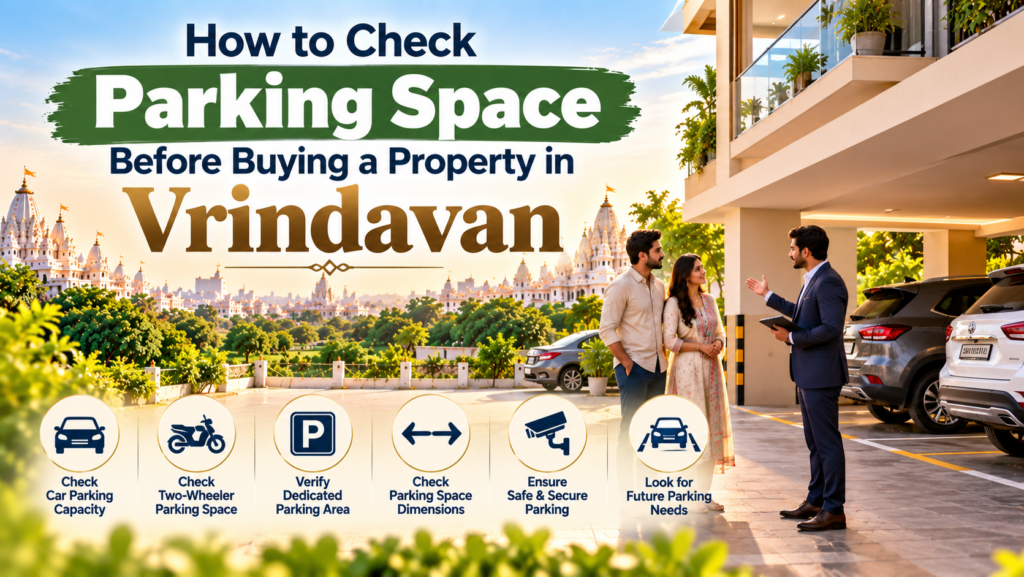
When buying a home, buyers often focus on the location, price, room sizes, floor plan and amenities. Parking is another practical factor that should be checked before finalizing a property.
A property may have a designated parking area, but its actual size, access, turning space and location can affect how convenient it is for everyday use.
If you are planning to buy a property in Vrindavan, checking the parking arrangement during a physical site visit can help you understand whether it suits your current and future requirements
Why Parking Matters When Buying Property
Conclusion
Parking can become an important part of daily convenience, particularly for families who own one or more vehicles.
Before buying, consider:
- Number of vehicles
- Parking size
- Vehicle entry
- Turning space
- Parking location
- Covered or open parking
- Visitor parking
- Access during busy periods
The parking arrangement should be evaluated together with the overall property and building layout.
1. Check the Actual Parking Space
Do not rely only on the statement that the property includes parking.
During your visit, check the actual space available.
Look at:
- Parking length
- Parking width
- Vehicle position
- Space around the vehicle
- Access to doors
- Space for movement
The available area should be practical for the type of vehicle you use.
2. Check Vehicle Entry and Exit
A parking space can be large enough but still difficult to use if the entry and exit are restricted.
Observe:
- Main gate width
- Driveway width
- Turning area
- Corners
- Nearby walls
- Other parked vehicles
- Entry and exit direction
If possible, check the space with an actual vehicle rather than judging it only from a plan.
3. Check Turning Space
Turning space is particularly important in apartment parking areas, narrow driveways and compact residential properties.
Consider whether you can:
- Enter comfortably
- Turn the vehicle
- Reverse safely
- Exit without excessive maneuvering
A simple site demonstration can provide a better understanding than photographs.
4. Check Covered and Open Parking
Find out whether the parking area is:
- Covered
- Semi-covered
- Completely open
Each arrangement has different practical considerations.
Covered parking may provide additional protection from weather, while open parking may have different access and maintenance requirements.
The choice should depend on your requirements and the property’s actual arrangement.
5. Check Whether Parking Is Dedicated
If you are buying an apartment or property within a residential development, ask whether the parking space is:
- Dedicated to the property
- Common parking
- Open parking
- Assigned parking
- Subject to society or project rules
Do not assume that a parking area visible during the site visit automatically belongs exclusively to the property.
Confirm the arrangement from the relevant property documents or project information.
6. Check Parking for Multiple Vehicles
If your family owns more than one vehicle, check the parking capacity before buying.
Think about:
- Cars
- Two-wheelers
- Additional family vehicles
- Guest vehicles
A property that works for one vehicle today may need a different parking arrangement if your vehicle requirements change later.
7. Check Two-Wheeler Parking
Even if you primarily own a car, two-wheeler parking can be useful.
Look for suitable space for:
- Motorcycles
- Scooters
- Bicycles
Also check whether two-wheelers can be moved without blocking the main vehicle or entrance.
8. Check Visitor Parking
For residential properties in a society or apartment development, find out whether visitors have designated parking.
Ask about:
- Visitor parking areas
- Guest vehicle access
- Parking restrictions
- Security procedures
- Peak-time parking
This can be particularly useful if you frequently have family or guests visiting.
9. Check Parking Near the Property Entrance
The distance between the parking area and the home can affect convenience.
Consider:
- Walking distance
- Staircase access
- Lift access
- Building entrance
- Security
- Lighting
For families, older residents or people carrying groceries and other items, convenient access between parking and the home may be useful.
10. Check Parking in Apartment Properties
If you are buying an apartment in Vrindavan, inspect the parking area separately from the apartment itself.
Check:
- Parking location
- Basement or open parking
- Ramp access
- Column placement
- Turning radius
- Parking markings
- Lift access
- Security
- Lighting
A parking space shown on a plan should also be compared with the actual parking area during the visit.
11. Check Basement Parking Conditions
If the property has basement parking, inspect the overall arrangement.
Look at:
- Ramp slope
- Entrance width
- Turning space
- Lighting
- Ventilation
- Water drainage
- Ceiling clearance
- Pillars and structural obstructions
Also ask how water is managed during heavy rainfall.
12. Check Road Access to the Parking Area
The parking area should not be evaluated separately from the road leading to it.
Check:
- Approach road width
- Internal road
- Gate location
- Traffic movement
- Roadside obstructions
- Vehicle accessibility
A good parking space can still be inconvenient if the approach road is difficult to navigate.
13. Check Parking During Different Times
Parking conditions can change depending on the time of day.
If possible, visit the property during different periods and observe:
- Morning vehicle movement
- Evening parking demand
- Visitor activity
- Internal traffic
- Availability of common parking
This can give you a better understanding of the property’s regular parking environment.
14. Check Parking Markings and Allocation
In a residential development, look for clearly identified parking spaces.
Check whether parking areas are:
- Numbered
- Marked
- Assigned
- Common
- Clearly separated
If parking allocation is important to your purchase, ask for the applicable documentation or written details.
15. Check for Obstructions
During your parking inspection, look for anything that could restrict vehicle movement.
Potential obstructions include:
- Columns
- Walls
- Poles
- Trees
- Utility structures
- Other vehicles
- Narrow corners
A parking space should be assessed based on usable access rather than just its stated dimensions.
16. Consider Future Vehicle Requirements
Your current vehicle may not be the only vehicle you use during the property’s ownership.
Think about whether you may need space for:
- A larger car
- A second vehicle
- A two-wheeler
- Family members’ vehicles
This can help you assess whether the parking arrangement is suitable for your longer-term requirements.
17. Check Safety and Security
Parking should also be assessed from a security perspective.
Depending on the property, check for:
- Lighting
- Security personnel
- CCTV coverage
- Controlled entry
- Visibility
- Safe pedestrian access
The exact security arrangements will vary by property and development.
18. Check Parking and Property Documents
For an important property purchase, do not rely only on verbal information about parking.
Where applicable, verify:
- Parking allocation
- Property plan
- Project documents
- Society rules
- Sale-related documents
- Applicable parking terms
If anything is unclear, ask the seller, developer or property representative for clarification before proceeding.
19. Compare Parking Between Properties
If you are considering multiple properties, use the same parking checklist for each one.
| Parking Factor | Property A | Property B |
|---|---|---|
| Parking size | Check | Check |
| Vehicle entry | Check | Check |
| Turning space | Check | Check |
| Covered/open | Check | Check |
| Dedicated parking | Check | Check |
| Visitor parking | Check | Check |
| Road access | Check | Check |
| Security | Check | Check |
| Future vehicle needs | Check | Check |
This can make your comparison more practical.
20. Include Parking in Your Property Inspection
Parking should be considered along with other important property factors.
Before buying a residential property in Vrindavan, evaluate:
- Location
- Connectivity
- Property condition
- Floor plan
- Natural light
- Ventilation
- Parking
- Maintenance
- Neighborhood
- Documentation
- Total purchase cost
A property should meet your overall requirements rather than being selected based on parking alone.
Parking Checklist for Property Buyers
Before finalizing a property, check:
Actual parking size
Vehicle entry and exit
Turning space
Covered or open parking
Dedicated parking status
Two-wheeler parking
Visitor parking
Road access
Basement conditions, if applicable
Parking markings
Obstructions
Lighting and security
Future vehicle requirements
Parking-related documents
Checking parking space in property in Vrindavan is an important practical step before buying a home. Buyers should look beyond the simple availability of parking and assess its size, accessibility, turning space, allocation, security and suitability for their vehicles.
During the site visit, try to experience the actual parking arrangement and compare it with the property information provided.
If you are planning to buy property in Vrindavan, evaluating parking along with the floor plan, location, property condition, maintenance, documentation and overall cost can help you make a more informed decision.