
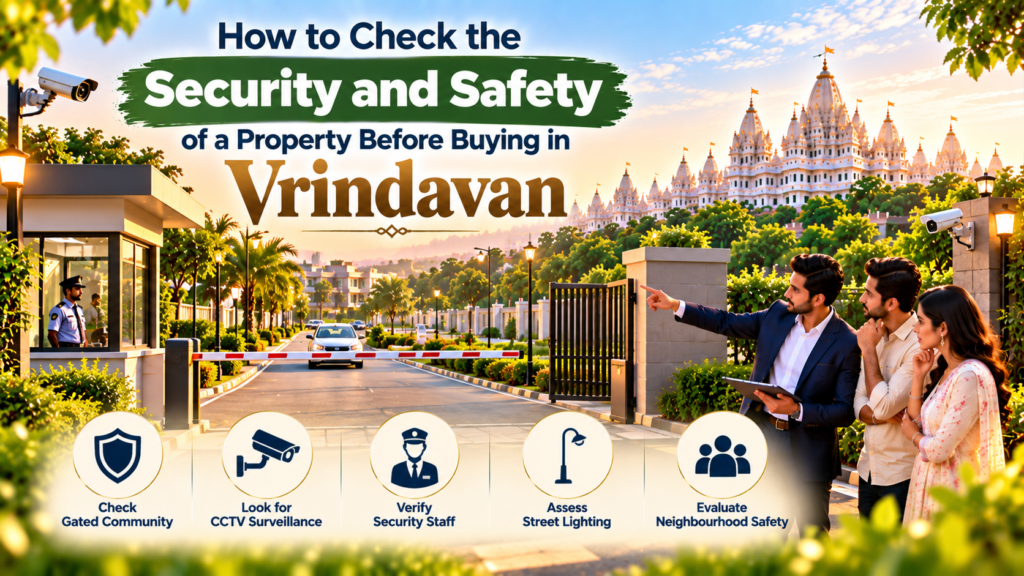
When buying a home, buyers usually focus on location, price, layout, amenities and connectivity. However, property security and safety in Vrindavan should also be evaluated before making a final decision.
Security arrangements can vary significantly between independent houses, apartments, gated communities and residential developments.
A physical inspection can help buyers understand how the property manages entry, visitors, parking, lighting and general security.
1. Check the Main Entrance
The main entrance is one of the first things to inspect during a property visit.
Check:
- Main gate
- Entry points
- Gate condition
- Visitor access
- Pedestrian entry
- Vehicle entry
- Boundary arrangements
For gated developments, ask how entry and exit are managed on a normal day.
2. Check Security Guard Availability
If the property is part of an apartment complex or gated community, find out whether security personnel are available.
Ask:
- Is security available 24/7?
- How many entry points are monitored?
- Are visitors checked?
- Is night security available?
- How is vehicle entry managed?
Security arrangements may differ between properties, so verify the actual setup rather than assuming it is the same everywhere.
3. Check CCTV Coverage
If CCTV cameras are provided, understand where they are installed.
Look for cameras covering areas such as:
- Main entrance
- Exit gate
- Parking
- Common corridors
- Lift areas
- Building entrances
- Other important common spaces
Also ask whether the cameras are operational and how footage is managed.
4. Inspect Boundary and Access Points
For independent houses and gated developments, inspect the property’s boundary arrangements.
Check:
- Boundary walls
- Gates
- Side access
- Rear access
- Open gaps
- Shared entrances
A property with multiple access points may require additional attention to how those points are secured.
5. Check Street Lighting
Good visibility around the property can be useful, particularly during evening and nighttime hours.
During your visit, observe:
- Streetlights
- Entrance lighting
- Parking lighting
- Pathway lighting
- Dark corners
- Common-area lighting
If possible, visit the property after sunset to see the actual lighting conditions.
6. Visit the Property During Different Times
A daytime visit may not provide a complete picture of the property’s environment.
Try visiting during:
- Morning
- Evening
- Night
- Weekends
Observe vehicle movement, pedestrian activity, entrance management and the general environment.
7. Check Parking Security
Parking areas should also be inspected from a security perspective.
Look for:
- Lighting
- CCTV
- Controlled access
- Security personnel
- Entry and exit arrangements
- Visibility from common areas
For apartment properties, ask how resident and visitor vehicles are managed.
8. Check Lift and Staircase Access
In multi-storey buildings, consider how people access residential floors.
Check:
- Lift access
- Staircase location
- Common entrance
- Access control
- Lighting
- Emergency exits where applicable
Ask whether visitors can freely access residential floors or whether access is controlled.
9. Check Fire and Emergency Arrangements
For apartments and larger residential developments, ask about available emergency arrangements.
Depending on the property, these may include:
- Fire extinguishers
- Fire alarms
- Emergency exits
- Fire-fighting systems
- Emergency access routes
- Clearly marked evacuation areas
The exact requirements and arrangements depend on the type and size of the property.
10. Check Emergency Vehicle Access
Emergency access should not be blocked by narrow entrances or poorly managed parking.
Observe whether there is practical access for:
- Ambulances
- Fire vehicles
- Other emergency services
For apartment communities, ask how emergency vehicles can access the building.
11. Check the Surrounding Area
Property security also depends partly on the immediate surroundings.
Look at:
- Nearby roads
- Empty plots
- Commercial areas
- Street activity
- Public movement
- Lighting
- Adjacent buildings
A property should be evaluated in the context of its surrounding neighborhood.
12. Speak With Existing Residents
If possible, speak with people already living in the property or nearby area.
You can ask about:
- Security arrangements
- Visitor management
- Parking issues
- Nighttime environment
- Common-area maintenance
- Emergency response
Residents may provide practical information that is difficult to understand from a short site visit.
13. Check Visitor Management
For apartments and gated developments, understand how visitors are handled.
Ask whether the property has:
- Visitor registration
- Security verification
- Entry records
- Visitor parking
- Delivery access
- Controlled gates
A clear visitor-management process can make the property easier to manage for residents.
14. Check Delivery and Service Access
Modern residential properties receive regular deliveries and service visits.
Consider how the property manages:
- Food deliveries
- Courier services
- Maintenance workers
- Domestic service providers
- Other visitors
The goal is to understand how access is managed without creating unnecessary inconvenience for residents.
15. Check Vacant Areas Around the Property
Vacant plots or undeveloped spaces near a property can affect visibility and nighttime surroundings.
Observe:
- Empty land
- Unused buildings
- Dark areas
- Uncontrolled access paths
- Construction sites
This does not automatically indicate a security problem, but it is worth considering as part of the overall property inspection.
16. Check Security During Nighttime
A nighttime visit can reveal details that are difficult to notice during the day.
Observe:
- Street lighting
- Building entrances
- Parking visibility
- Security presence
- Road activity
- Common-area lighting
If you are seriously considering a property, a short evening visit can provide useful additional information.
17. Check Security Rules Before Buying
For properties managed by a society, association or gated development, ask about applicable rules.
These may cover:
- Visitor entry
- Parking
- Delivery access
- Security timings
- Resident identification
- Common-area use
Understanding these rules before purchase can prevent surprises later.
18. Consider the Property Type
Different property types require different security checks.
Independent House
Pay attention to:
- Boundary walls
- Main gate
- Side and rear access
- Street lighting
- Nearby surroundings
Apartment
Check:
- Main building entry
- Lift access
- CCTV
- Security personnel
- Parking
- Emergency systems
Gated Residential Development
Check:
- Entry gates
- Visitor management
- Security personnel
- Internal roads
- CCTV
- Common-area lighting
Property Security Checklist
| Security Factor | What to Check |
|---|
| Main Gate | Entry and exit management |
| Security Guards | Availability and timings |
| CCTV | Coverage and operation |
| Boundary | Walls, gates and access points |
| Lighting | Roads, parking and common areas |
| Parking | Security and controlled access |
| Lift/Entry | Residential floor access |
| Emergency | Fire and emergency arrangements |
| Visitors | Registration and access |
| Surroundings | Nearby roads and vacant areas |
| Night Conditions | Lighting and activity |
| Security Rules | Society or development policies |
Common Mistakes Buyers Should Avoid
Checking Security Only During the Day
Nighttime conditions can be very different from daytime conditions.
Assuming CCTV Means Complete Security
Cameras are only one part of a property’s overall security arrangements.
Ignoring Entry and Exit Points
Multiple or poorly controlled access points should be carefully evaluated.
Not Asking Existing Residents
Residents can often provide useful information about how security arrangements work in everyday situations.
Ignoring Emergency Access
Make sure emergency routes and access arrangements are practical for the property type.
Conclusion
Evaluating property security and safety in Vrindavan is an important part of the home-buying process. Buyers should inspect gates, security personnel, CCTV, lighting, parking, boundaries, visitor management and emergency access before making a decision.
A property should be evaluated not only during a daytime site visit but also, where practical, during evening or nighttime hours.
If you are planning to buy property in Vrindavan, combining a security inspection with checks of the property’s location, layout, maintenance, surroundings and documentation can help you make a more informed decision.