
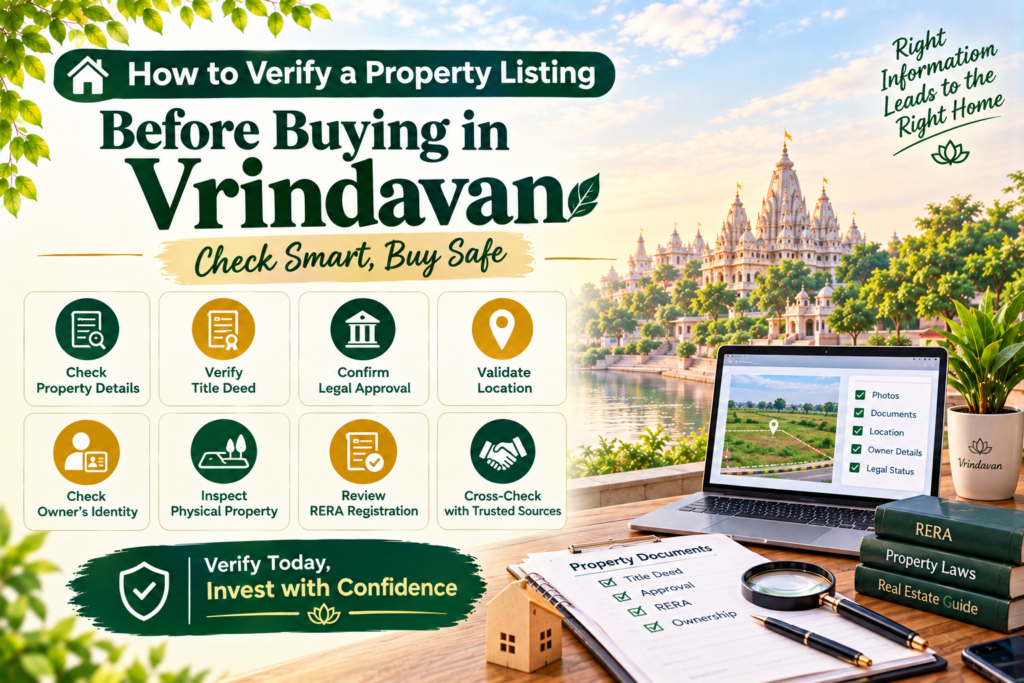
Introduction
Online property listings make it easier to discover properties, compare options, and contact sellers or real estate companies. However, the information shown in a listing should not be treated as the final basis for making a purchase decision.
Before buying property in Vrindavan, buyers should verify important details about the property, its location, specifications, ownership, applicable approvals, and overall cost.
Knowing how to verify property listing in Vrindavan can help buyers identify discrepancies early and make a more informed decision.
Why Should You Verify a Property Listing?
A property listing may provide information about:
- Property size
- Location
- Price
- Number of rooms
- Amenities
- Road access
- Project details
- Contact information
However, some details need to be independently confirmed.
Verification is important because the property you see online should match the property available at the actual location and the relevant documentation.
1. Verify the Exact Property Location
The first step is to confirm the exact location.
Do not rely only on a general area name. Ask for sufficient location details to identify the actual property.
Check:
- Exact location
- Nearby roads
- Approach route
- Surrounding development
- Distance from important destinations
- Accessibility
If possible, visit the property yourself before making a financial commitment.
2. Compare the Listed Property With the Actual Site
The information shown online should match what you see during the site visit.
Compare:
- Property size
- Layout
- Road access
- Number of floors
- Open space
- Parking
- Surrounding buildings
- Available amenities
If there is a significant difference between the listing and the actual property, ask for clarification before proceeding.
3. Verify the Property Size
Property size is an important factor when comparing property in Vrindavan.
Ask whether the stated size refers to:
- Plot area
- Built-up area
- Carpet area
- Super built-up area
- Other applicable measurement
For land, also check the actual dimensions and boundaries.
Understanding exactly what area is being quoted can prevent confusion when comparing different properties.
4. Check the Listed Price Carefully
The price displayed in a listing may not always represent the complete cost of purchase.
Ask about:
- Basic property price
- Registration-related expenses
- Applicable taxes and charges
- Maintenance charges
- Development charges, where applicable
- Parking charges, if applicable
- Other transaction-related costs
Ask for a clear breakdown of the total expected cost before making a decision.
5. Verify Ownership and Property Documents
One of the most important parts of property verification in Vrindavan is checking the relevant documents.
Depending on the property, buyers may need to review:
- Ownership documents
- Title-related records
- Previous transaction documents
- Property tax records, where applicable
- Applicable approvals
- Land-use information
- Layout or development documents, where applicable
The exact documents required depend on the type and status of the property.
For an important property transaction, professional legal verification can help identify potential issues.
6. Check Applicable Approvals
If the property is part of a development or construction project, ask about the approvals and permissions applicable to it.
Do not assume that a property is approved simply because the listing describes it as approved.
Request relevant documentation and verify it through appropriate sources or professionals where necessary.
7. Verify the Property’s Intended Use
The intended use of a property matters.
A property intended for residential use should be evaluated differently from commercial property or land with another designated use.
Before buying, verify the applicable land-use status and whether your intended use is permitted.
8. Check Road Access and Connectivity
A property may be advertised as being close to a major road or important destination.
Instead of relying only on the description, check the actual route.
Evaluate:
- Approach road
- Road width
- Accessibility
- Traffic conditions
- Public transport availability, where relevant
- Distance to essential facilities
A site visit can provide a much better understanding of actual connectivity.
9. Inspect the Surrounding Area
The property itself is only one part of the buying decision.
During your visit, observe the surrounding neighborhood.
Check:
- Existing residential development
- Nearby shops
- Schools or essential services, where relevant
- Road conditions
- Construction activity
- Drainage
- Electricity infrastructure
- General surroundings
The surrounding area can influence the property’s suitability for your intended use.
10. Verify Amenities Instead of Assuming Them
Listings often mention amenities or facilities.
If amenities are important to you, ask which facilities are currently available and which are planned.
For example, distinguish between:
Currently Available
and
Proposed or Planned
This can help you understand the actual condition of the property or development.
11. Check the Property’s Condition
For a ready property, inspect the physical condition before buying.
Look at:
- Walls and ceilings
- Flooring
- Doors and windows
- Plumbing
- Electrical systems
- Water supply
- Ventilation
- Parking
- Common areas
If you are not familiar with construction quality, consider getting an independent inspection.
12. Verify the Seller or Developer Details
Before sharing significant personal information or making a payment, verify who you are dealing with.
Check:
- Seller’s identity
- Developer or company details
- Office information
- Property-related credentials
- Transaction documents
Be cautious if someone pressures you to make an immediate payment without allowing reasonable time for verification.
13. Never Skip the Site Visit
One of the simplest ways to verify property details is to visit the property.
A site visit can help you confirm:
- Location
- Property size
- Road access
- Surroundings
- Physical condition
- Construction status
- Available infrastructure
If possible, visit more than once before finalizing the purchase.
14. Compare the Listing With Other Properties
Do not evaluate a property in isolation.
Compare similar properties based on:
| Factor | Property A | Property B | Property C |
|---|---|---|---|
| Location | |||
| Property Type | |||
| Size | |||
| Price | |||
| Road Access | |||
| Amenities | |||
| Condition | |||
| Documents | |||
| Total Cost |
This can help you understand whether the listed property fits your requirements and budget.